Key events and trends
-
Kubernetes Scheduler Reduces Carbon Emissions by 50% for Deferrable Workloads: Dave Masselink, Software Engineer and Founder at Compute Gardener, detailed how their scheduler achieved significant carbon emission reductions. The savings result from temporal shifting of workloads to periods when the power grid has lower carbon intensity, rather than improving energy efficiency, highlighting opportunities for "carbon emission arbitrage" in grids with fluctuating intensity. (источник)
-
KubeIntellect for English-based Kubernetes Troubleshooting: A new tool, KubeIntellect, allows users to troubleshoot Kubernetes clusters using plain English queries. It performs checks across
kubectl, Prometheus, and Loki, requiring human approval before implementing any cluster changes. (источник)
-
Challenges of AI Review in Complex Kubernetes Systems: Artem Lajko noted that AI review capabilities are limited in rich-context systems, such as Kubernetes environments with cascading Helm charts and domain-specific assumptions. In such cases, AI models may produce plausible but ultimately unsuitable outputs for the actual platform. (источник)
-
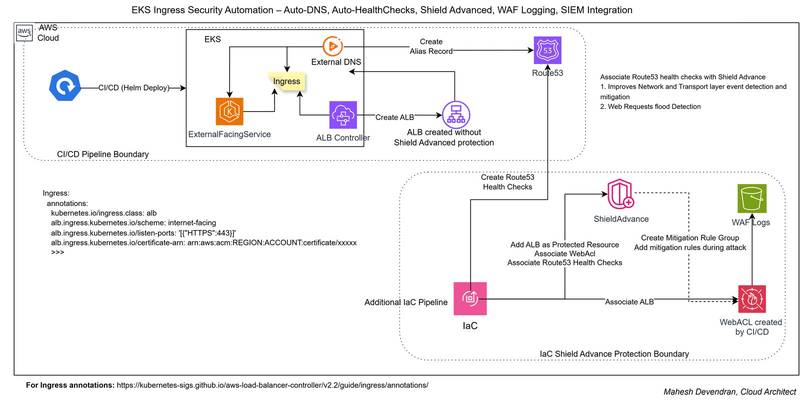
Protecting Public EKS Load Balancers with AWS Security Services: An article provided a guide on securing public EKS (Elastic Kubernetes Service) load balancers using a combination of AWS WAF, Shield Advanced, and Route 53, including methods for automatic checks and cleanup. (источник)
-
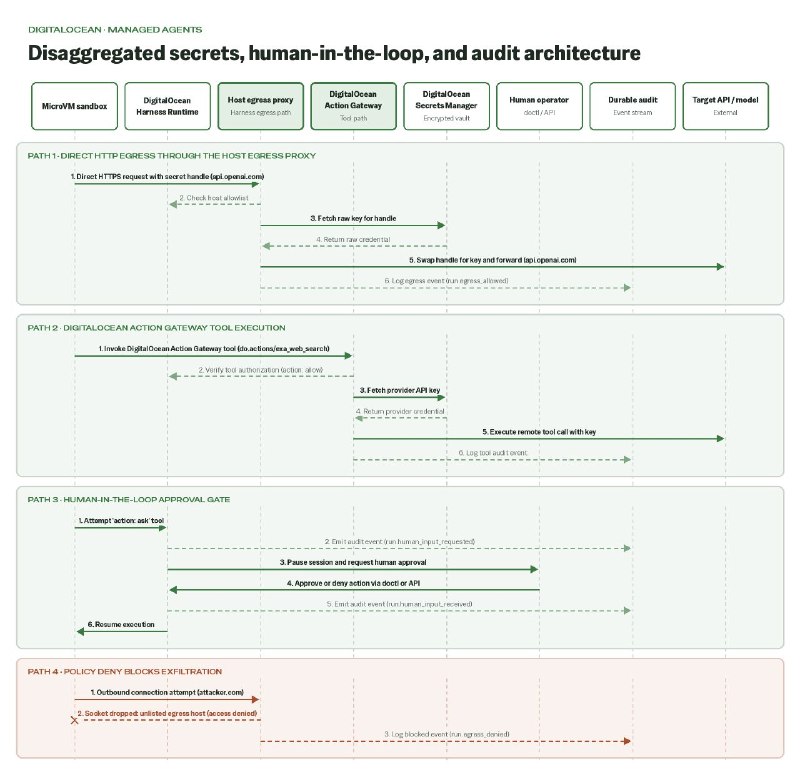
DigitalOcean's Credential Management for Autonomous Agents: DigitalOcean shared its strategy for managing credentials for autonomous agents, which involves preventing agents from directly holding live credentials. Instead, it uses ephemeral execution-time brokering via Action Gateway and strict runtime boundaries, aligning with NVIDIA's Open Agent Safety Platform and OpenShell policy schemas to mitigate data exfiltration and control blast radii across agent swarms. (источник)
-
ClickHouse Introduces TimeSeries Engine as Prometheus Replacement: ClickHouse launched a new TimeSeries Engine with PromQL support. This enables users to store Prometheus metrics directly in ClickHouse Cloud and query them using familiar PromQL, facilitating the integration of metrics with logs and traces without needing to rewrite queries in SQL. (источник)
-
Wardline: Open-Source Control Plane Proxy for AI Agents: Wardline, an open-source control plane proxy for AI agents, was introduced. It functions as a "proxy" to manage and control agent actions by intercepting requests, identifying identities, applying policies (supporting YAML, OPA/Rego, and Cedar formats), assessing budget usage, and detecting anomalies. The system logs all actions and offers features like SSO, RBAC, and approval rules, with a graphical web interface for monitoring. (источник)
Final analytics
The day's discussions and news highlight a strong focus on enhancing server infrastructure management, security, and operational efficiency within the Kubernetes and DevOps ecosystem. Key themes included:
- Sustainability and Efficiency: The introduction of a Kubernetes scheduler for carbon emission reduction demonstrates a growing trend towards environmentally conscious infrastructure management. This move beyond traditional energy efficiency to temporal workload shifting represents an innovative approach to reducing the environmental impact of compute resources.
- Advanced Troubleshooting and Monitoring: Tools like KubeIntellect, enabling English-based Kubernetes troubleshooting, and ClickHouse's new TimeSeries Engine as a Prometheus replacement, indicate a drive towards more accessible and integrated observability solutions. These advancements aim to simplify complex monitoring tasks and provide a unified view of system health.
- Security for Evolving Workloads: Several announcements emphasized robust security measures, particularly for cloud-native and autonomous agent environments. Protecting EKS load balancers and DigitalOcean's approach to credential management for agents, alongside the Wardline control plane, underscore the critical need for sophisticated DevSecOps practices to safeguard dynamic and distributed systems against data exfiltration and other threats.
The overall tone is forward-looking and solution-oriented, with a clear emphasis on leveraging new technologies (like AI) while acknowledging their limitations and developing specific security and management layers to address them. The absence of specific chat discussions prevents a detailed analysis of community sentiment, but the presented news items reflect active development and innovation in core areas of server infrastructure and its security.