Key events and trends:
-
New
kubectl treeplugin released for visualizing Kubernetes object hierarchies.- Details: A new
kubectlplugin,kubectl tree, has been released. It followsownerReferencesto print the entire object tree under a Deployment or custom resource, aiding in understanding creation dependencies. (источник)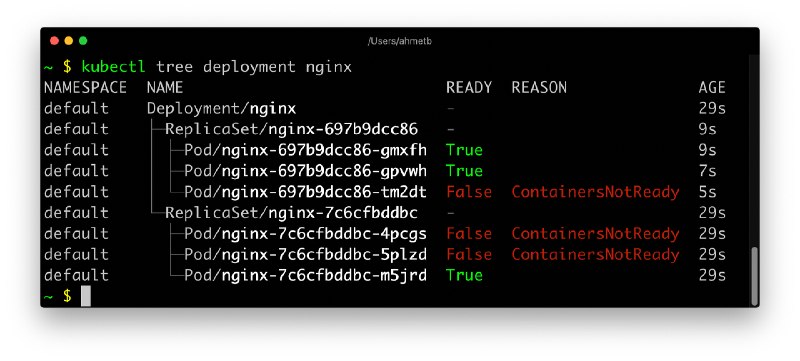
- Details: A new
-
Agentic AI expected to fundamentally simplify Kubernetes operations in the next decade.
- Details: Greg Eppel predicts that as Kubernetes celebrates its 10th anniversary, agentic AI will drive significant simplification in operations, leading to more autonomous actions and requiring human intervention only when essential. (источник)
-
A tool for generating JSON schemas from Helm charts is now available.
- Details: The
helm-schemaGitHub project provides functionality to generate JSON schemas directly from Helm charts, potentially enhancing validation and adherence to defined configurations. (источник)
- Details: The
-
Three old Kubernetes CVEs will not receive code fixes, requiring cluster-level changes.
- Details: An article explains that certain long-standing Kubernetes CVEs will not be patched with code fixes. It advises users on necessary cluster configuration changes to mitigate these vulnerabilities, especially as scanners are expected to flag them again. (источник)
-
Scenario released for evaluating Agentic SOC against a GitHub Actions to Kubernetes to AWS attack chain.
- Details: A downloadable multi-source log dataset has been provided for benchmarking Agentic SOC (Security Operations Center) harnesses. The scenario simulates a 7-phase attack, beginning with GitHub Actions cache poisoning and progressing through Kubernetes to AWS. (источник)

- Details: A downloadable multi-source log dataset has been provided for benchmarking Agentic SOC (Security Operations Center) harnesses. The scenario simulates a 7-phase attack, beginning with GitHub Actions cache poisoning and progressing through Kubernetes to AWS. (источник)
-
DryRun Security introduces its Contextual Security Analysis model, SLIDE.
- Details: DryRun Security has published a document outlining their SLIDE model for contextual security analysis. This model aims to prioritize security findings by considering parameters such as Surface, Language, Intent, Detection, and Environment, addressing limitations of deterministic approaches. (источник)
-
Guidance provided on three paths for connecting on-premise applications to cloud services.
- Details: Raglin Anthony detailed three methods for connecting on-premise applications to cloud services: public internet with HTTPS, AWS Site-to-Site VPN, and AWS Direct Connect. The discussion emphasized the critical role of DNS resolution across environments as a final step. (источник)
Live discussions:
No significant live discussions were observed in the monitored groups for this period.
Social graph:
No active participants were identified in discussions for this period.
Final analytics:
The Kubernetes & DevOps sphere on September 14, 2026, was characterized by informative channel publications, with no recorded activity or discussions in the monitored chat groups. The day's focus spanned core infrastructure tooling, future operational trends, and critical security considerations. New tools like kubectl tree for enhanced visibility and helm-schema for configuration management were highlighted. Looking forward, the potential for agentic AI to simplify Kubernetes operations was a notable forecast. Security continued to be a central theme, with insights into unfixable Kubernetes CVEs necessitating manual mitigations, a practical attack scenario for Agentic SOC evaluation, and a new contextual security analysis model (SLIDE) designed to improve prioritization of vulnerabilities. Discussions also covered robust connectivity solutions for hybrid cloud environments. The absence of group engagement suggests a quiet day for community interaction, with information flow primarily unidirectional from channels.