Key events and trends
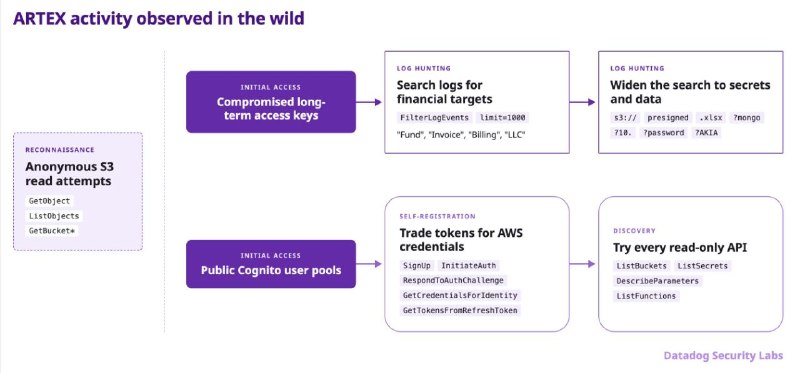
- Datadog reports on ARTEX LLM-agent attacks in AWS environments: Datadog's Security Labs identified "ARTEX," an LLM-agent penetration framework, actively exploiting AWS. Attack vectors included compromised long-term IAM keys used for CloudWatch FilterLogEvents to search for financial data and secrets, and anonymous public Cognito user pool sign-ups leading to token and credential enumeration (источник).
- Falco for real-time Linux system call and container activity monitoring: Falco provides real-time observation of Linux system calls and container behavior, issuing alerts when rules detect suspicious activities such as unexpected shell execution, file changes, or privilege escalation (источник).
- AI agents in Kubernetes production operations and deterministic policy enforcement: Philippe Ensarguet from Orange proposed that AI agents could assist in production operations by observing systems and formulating hypotheses using probabilistic reasoning. However, critical permission decisions and policy checks should remain deterministic. He noted that Kubernetes already incorporates such enforcement capabilities through its controllers and policies (источник).
- kopiur for Kubernetes PVC backups and snapshot management: The
kopiurtool allows users to manage Kopia repositories and snapshots as Kubernetes resources. It facilitates scheduled PVC backups, restores, retention policies, maintenance, and repository replication, all managed through Custom Resource Definitions (CRDs) (источник). - Analysis of Java OOMKilled in Kubernetes due to off-heap memory: Andrey Zhukovskiy explored why Java pods might receive an OOMKilled signal in Kubernetes even when their heap memory is only partially utilized. He demonstrated how off-heap memory can lead to container termination, discussing JVM settings, memory limits, Garbage Collector specifics, and introducing
jvm-fit, a tool designed to pre-check Kubernetes manifests for potential memory-related issues before deployment (источник).
- Rusticide: a satirical GitHub repository for radical vulnerability management: A GitHub repository named "Rusticide" was highlighted, humorously proposing to address vulnerabilities by automatically rewriting entire applications into Rust (or Erlang) and force-pushing them to the main branch. This process is triggered by GitHub Security Advisories and CVSS scores. The author explicitly states it's a joke "taken seriously enough to work" (источник).
Live discussions
- No live discussions were observed on topics outside of channel news/facts for this period.
Social graph
- No participant contributions were observed in group chats for this period.
Final analytics
The day's events highlight a strong focus on core server infrastructure, particularly Kubernetes, and various aspects of its security and operational integrity. Key themes include advanced threat detection with Falco, cloud security vulnerabilities in AWS (ARTEX LLM-agent attacks), and robust data protection for Kubernetes PVCs via kopiur. The discussion around AI agents in Kubernetes operations suggests an evolving landscape where AI supports, but doesn't fully replace, deterministic security and policy enforcement.
A notable deep dive into Java application performance within Kubernetes, specifically OOMKilled issues related to off-heap memory, underscores the ongoing challenges in optimizing containerized applications and the importance of precise resource management. While most news focused on practical tools and emerging threats, the satirical "Rusticide" project offers a humorous, yet thought-provoking, commentary on radical approaches to vulnerability management, reflecting broader industry conversations about security remediation strategies.
The absence of group chat discussions for the day indicates a quiet period in community engagement or a lack of immediately impactful news that would spur conversation within the monitored groups. This creates an information gap regarding community sentiment, specific pain points, or practical experiences related to the reported news. Consequently, the digest primarily reflects vendor announcements and analytical reports rather than peer-to-peer insights or live problem-solving discussions.